
Guide
Men’s watch sizes: what the label covers, the average man’s wrist, and what fits a 6.5, 7 or 7.5 inch wrist
What a seller’s men’s range covers, what five published guides pair with 6.5, 7 and 7.5 inch wrists, where they disagree, and the average wrist in a US Army survey of 4,082 men.
Men’s watch size is a seller’s shelf label, not a measurement: the ranges we read run from 38 to 46 mm at Alpina, Gnomon, Goldsmiths and Timex, 39 to 44 mm at Second Movement and 40 to 46 mm at Shinola. For a 6.5 to 7 inch wrist, three guides give 38 to 42 mm or close to it.
Everything here rests on published numbers, not photographs of watches on wrists. We read size guides from the sellers above and from Helzberg, Jewelers Mutual, Oracle of Time and others, and the makers’ own pages for the watches we name, all last checked 9 November 2026. We did not handle or test any watch, and where guides disagree we show both and average nothing. Shares of wrists come from the US Army’s ANSUR II survey of 2012 (4,082 men and 1,986 women, US Army personnel including reservists), a US proxy and not a sample of UK adults; we found no public UK dataset. To measure your own wrist, use our watch size guide.
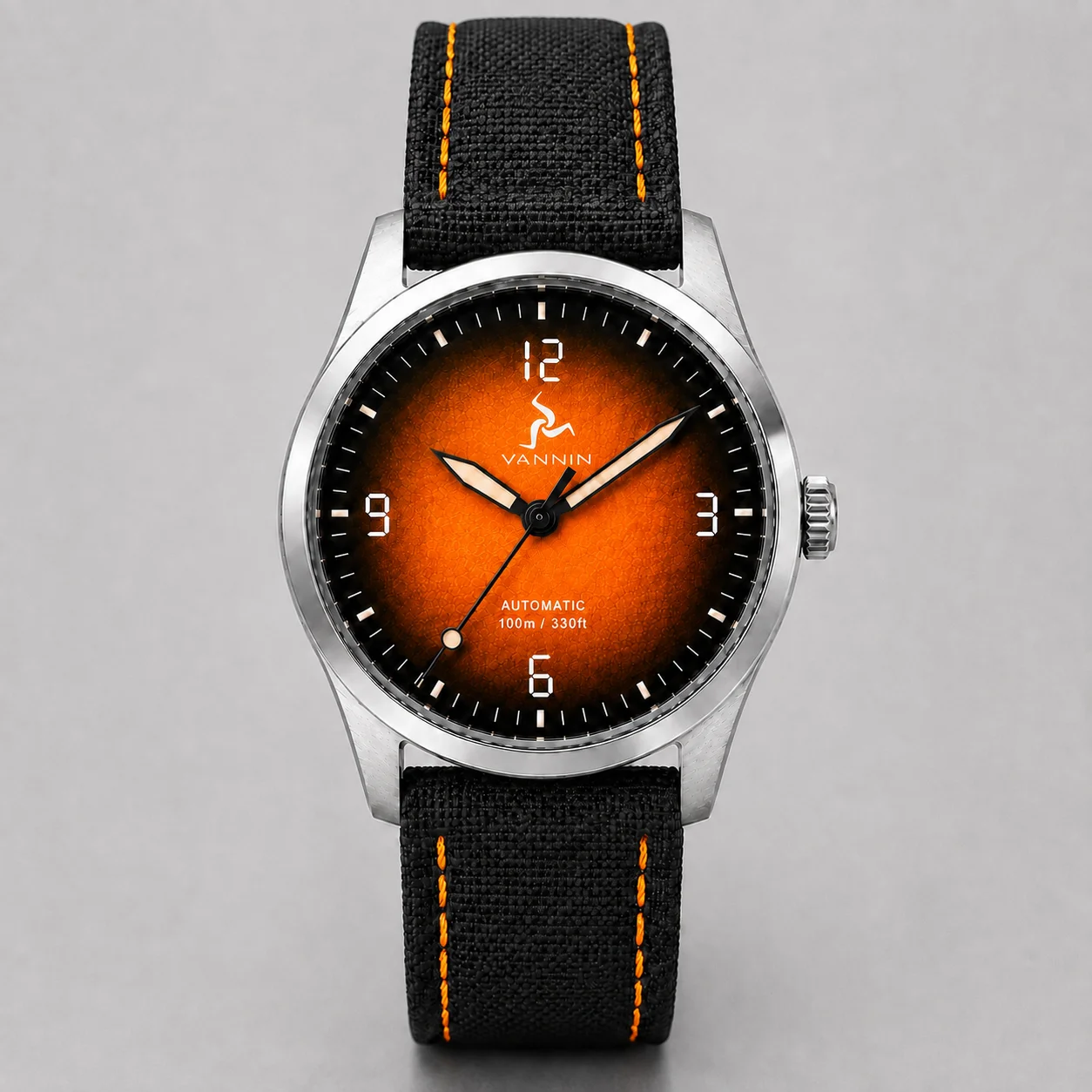
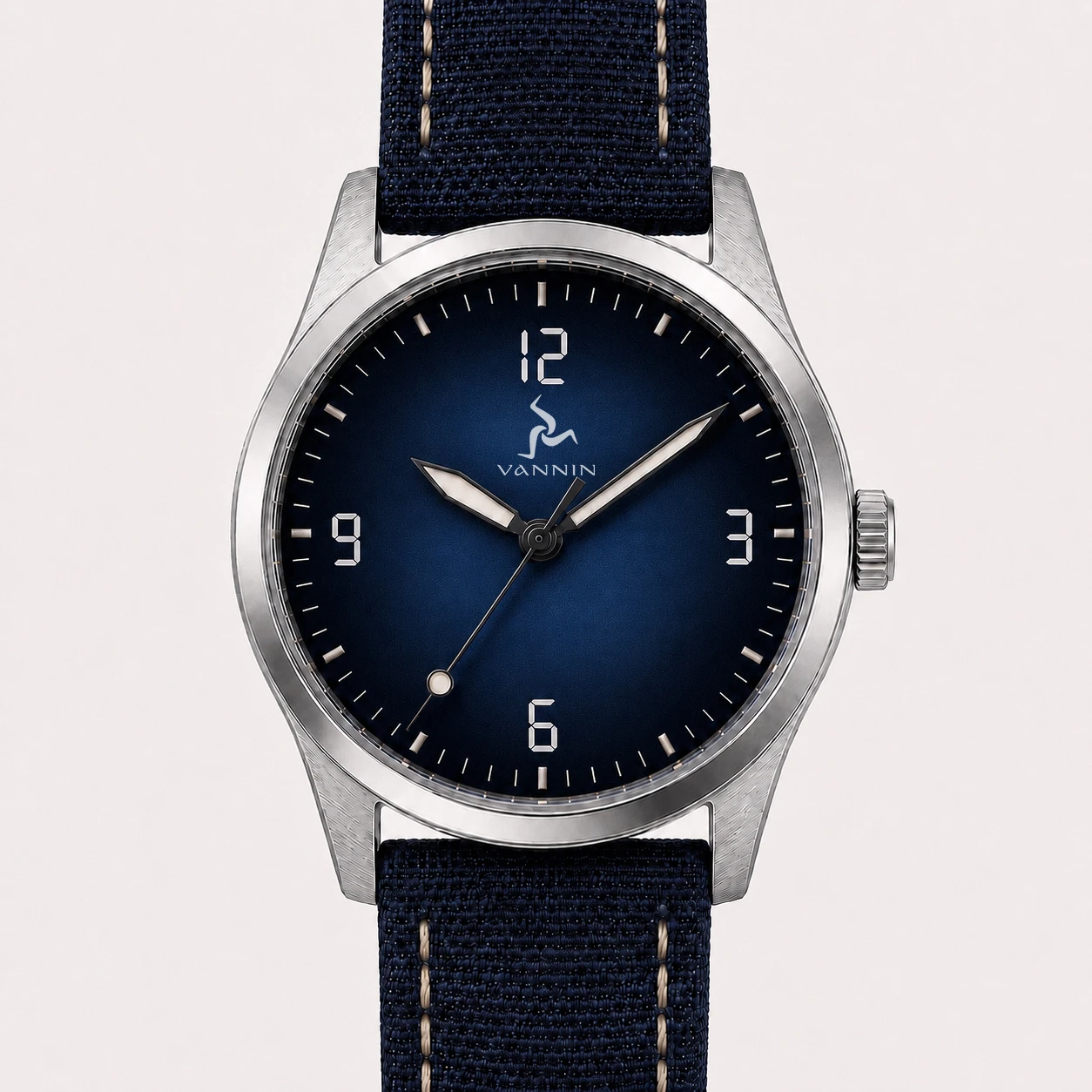
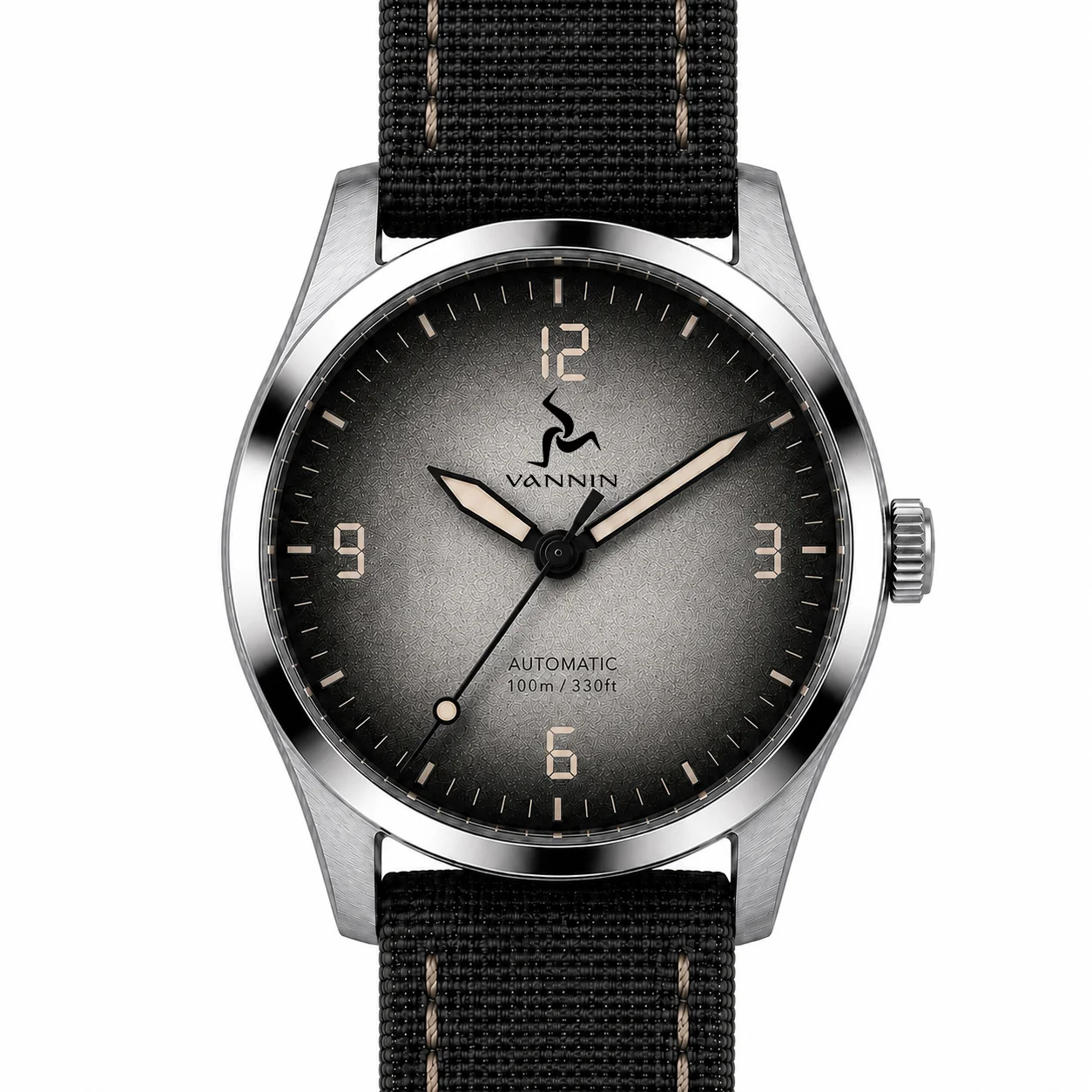
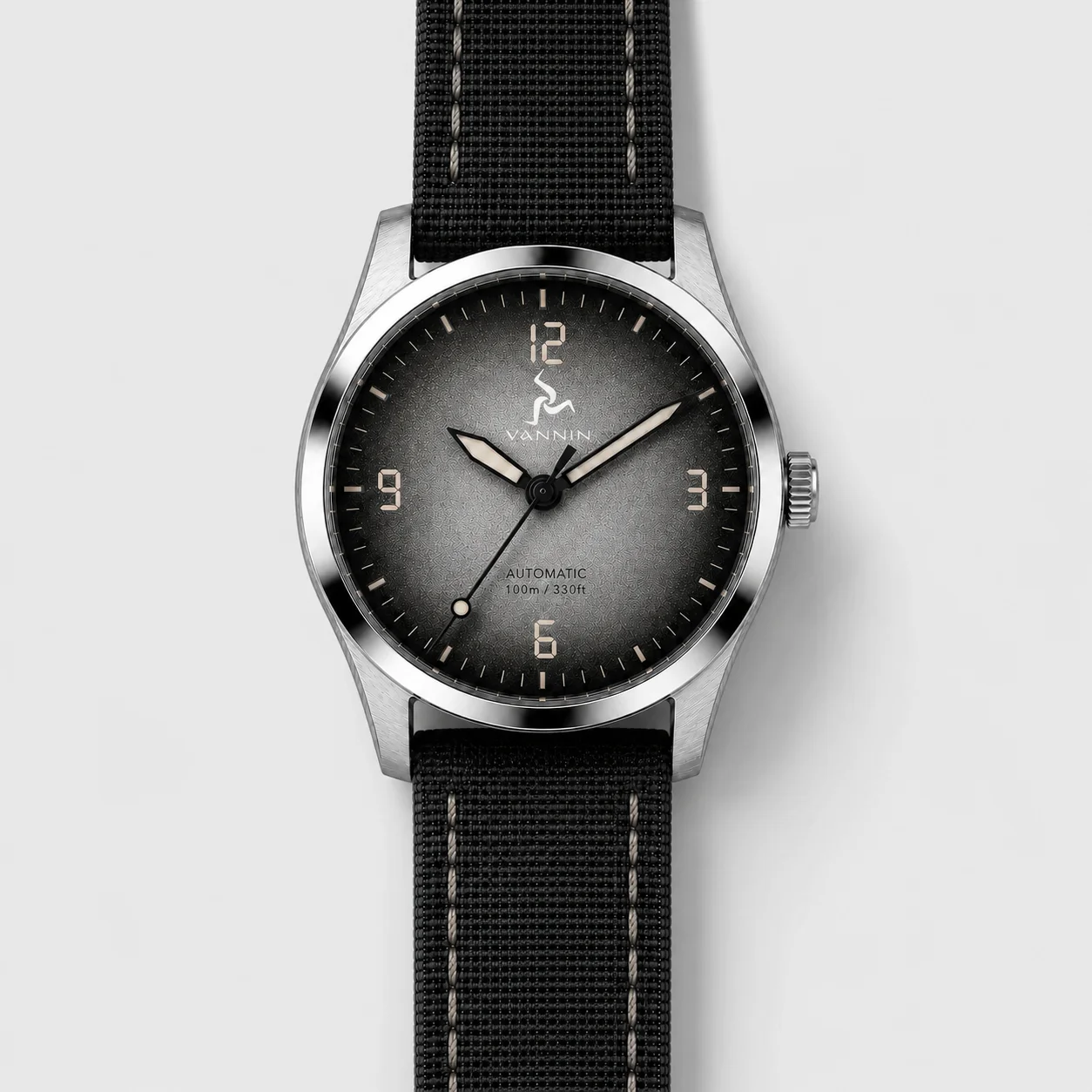
Disclosure: we are Vannin Watches, a Manx brand designed on the Isle of Man, and our first watch has a 38.0 mm case, which sits near the bottom of several sellers’ ranges, so we have a stake in this page (The Field Watch is coming soon, and its numbers appear only in the last section).
Sellers use “men’s” as a shelf label for a band of case diameters, and the bands differ by a millimetre or two at the bottom and at the top. Table 1 gives the men’s range at six sellers with each seller’s own hedge, the date on the page, if any, and the source the page gives.
| Seller | Men’s range | The seller’s qualifier | Date shown on the page | Source the page gives for the range |
|---|---|---|---|---|
| Alpina | 38 to 46 mm | generally | none | none; calls the ranges useful guidelines |
| Gnomon | 38 to 46 mm | usually | 25 April 2024 | none for the numbers; one image is captioned “Source: Neatopia” |
| Goldsmiths | 38 to 46 mm | typically, tend to range | none | none |
| Second Movement | 39 to 44 mm | often set within | 26 August 2025 | none named; says its figures combine wrist measurements with widely accepted industry standards |
| Shinola | 40 to 46 mm | typically | none | none; calls them general guidelines |
| Timex | 38 to 46 mm | tend to be | 14 May 2025 | none |
Four of the six sellers give the same 38 to 46 mm. Second Movement’s men’s range is 39 to 44 mm, and it also lists 39 mm in its unisex range. Shinola calls 38 to 42 mm unisex sizes and starts its men’s range at 40, so a 38 mm or 39 mm size can sit on one seller’s unisex shelf and another’s men’s shelf.
How the unisex label overlaps these ranges is covered in our guide to unisex watches. None of the six pages names a source for its range, which is why we treat these as labels and not standards.
Two sellers add a claim about popularity. Goldsmiths’ guide says 42 mm is the most popular men’s size, and Helzberg, a US jeweller, says on a page dated 23 June 2026 that men often go for larger styles in the 40 to 46 mm range and that the most popular sizes typically run from 38 mm to 42 mm. Neither gives a source, a date or a sales figure, so we report them as the sellers’ statements, not as findings.
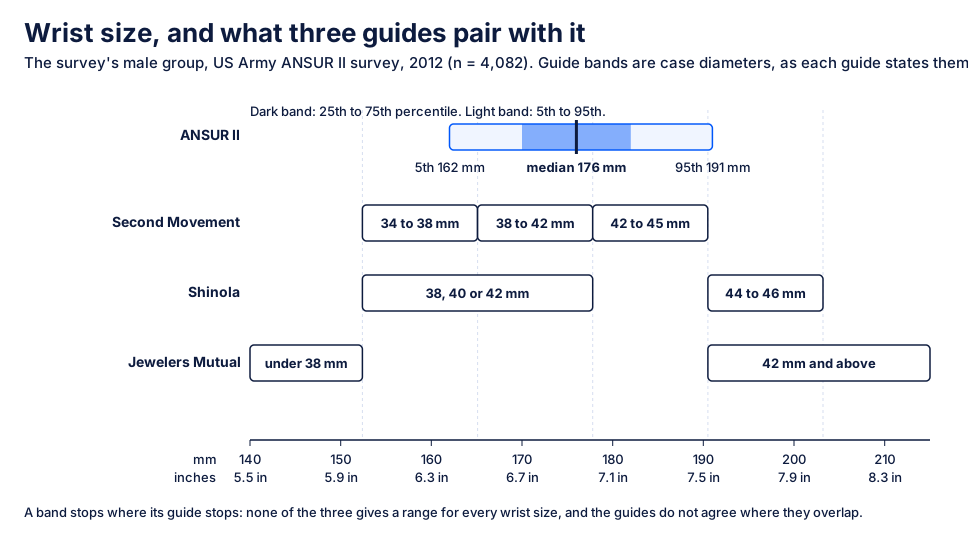
None of the guides we read splits its wrist bands by label, so a chart by wrist is one chart for every wrist, and it becomes a men’s chart only when it is read against how common each wrist size is among men. For a 6.5 to 7 inch wrist the guides give 38 to 42 mm, 38, 40 or 42 mm and 39 to 42 mm, and they disagree most at the small and large ends.
The share of men in each band is from ANSUR II, counted in half-inch bands whose edges are 152, 165, 178 and 190 mm (inches at 25.4 mm each, rounded to the nearest millimetre), with a wrist on an edge placed in the higher band.
| Wrist | Share of ANSUR II men (n = 4,082) | Second Movement | Shinola | Helzberg | Jewelers Mutual | Oracle of Time (lug-to-lug) |
|---|---|---|---|---|---|---|
| Under 6.0 in (under 152 mm) | 0.2% | no entry | no entry | 33 mm and under, or 34 to 38 mm (guide says under 6 in) | under 38 mm, and under 10 mm deep (guide says under 6 in) | below 47 mm (guide says under 6.5 in) |
| 6.0 to 6.5 in (152 to 164 mm) | 9.4% | 34 to 38 mm | 38, 40 or 42 mm (guide says 6 to 7 in) | 39 to 42 mm, or 36 mm (guide says 6 to 7 in) | no entry | below 47 mm (guide says under 6.5 in) |
| 6.5 to 7.0 in (165 to 177 mm) | 48.2% | 38 to 42 mm | 38, 40 or 42 mm (guide says 6 to 7 in) | 39 to 42 mm, or 36 mm (guide says 6 to 7 in) | no entry | 46 to 50 mm |
| 7.0 to 7.5 in (178 to 189 mm) | 35.5% | 42 to 45 mm | no entry | 43 to 46 mm or larger (guide says over 7 in) | no entry | 50 mm and beyond (guide says 7 in and over) |
| 7.5 in and over (190 mm and over) | 6.7% | no entry | 44 to 46 mm (guide says 7.5 to 8 in) | 43 to 46 mm or larger, and 47 mm and above for bold designs (guide says over 7 in) | 42 mm or more, and 12 to 14 mm or more deep (guide says 7.5 in or more) | 50 mm and beyond (guide says 7 in and over) |
Wrists of 152 to 164 mm are 9.4% of the men in the survey group. Second Movement says 34 to 38 mm, and 38 mm is where Shinola’s 6 to 7 inch list begins. Helzberg’s 6 to 7 inch band starts at 39 mm, with 36 mm as its scaled-down option. No men’s range in Table 1 starts below 38 mm, so on this band the only guidance we found is in the guides’ wrist bands, which reach down to 34 mm at Second Movement and 36 mm at Helzberg. Oracle of Time asks for a lug-to-lug below 47 mm.
This is the largest band, 48.2% of the men in the survey group (165 to 177 mm), and the guides agree here more than anywhere else: 38 to 42 mm at Second Movement, 38, 40 or 42 mm at Shinola and 39 to 42 mm at Helzberg. Our reading, not a guide’s: 40 and 42 mm are the two sizes that every one of those bands includes for this wrist and that sit inside every men’s range in Table 1. Oracle of Time puts the lug-to-lug at 46 to 50 mm.
Here the guides part company. Second Movement says 42 to 45 mm and Helzberg 43 to 46 mm or larger, but Shinola’s two lists leave the half-inch blank and Jewelers Mutual gives nothing until 7.5 in. Second Movement’s own FAQ adds that a 44 mm watch can be large on a 7 inch wrist and suggests 40 to 42 mm, which is below its 42 to 45 mm band for the next half-inch. Oracle of Time says 50 mm and beyond for the lug-to-lug. In the survey group 35.5% of men have wrists of 178 to 189 mm.
Wrists of 190 mm and over are 6.7% of the men in the survey group: 6.4% at 7.5 to 8.0 in and 0.3% above. Shinola’s second list is 44 to 46 mm for 7.5 to 8 in. Jewelers Mutual puts diameter at 42 mm or more and depth at 12 to 14 mm or more, and Helzberg says 43 to 46 mm or larger, adding that bold designs can be 47 mm and above. Second Movement gives no band here and puts 45 mm and above in what it calls the oversized category. Oracle of Time says 50 mm and beyond for the lug-to-lug.
In the ANSUR II male group (4,082 men) the mean wrist circumference was 175.9 mm, which is 6.93 in or 17.6 cm, and the 5th to 95th percentile ran from 162 to 191 mm (6.38 to 7.52 in). By half-inch band, 48.2% measured 6.5 to 7.0 in and 35.5% measured 7.0 to 7.5 in. The median, 176 mm (6.93 in), sits in the band where the guides in Table 2 agree most.
Three caveats come with these figures. Penn State’s data page itself warns that the sample is not an approximation of the US civilian population, and it holds serving US Army personnel, reservists included. It is a US proxy, not UK adults. And wrist circumference was taken at a defined landmark, not necessarily where you would measure for a watch, so your own tape reading is the number that counts.
Our guide to average wrist size gives the percentiles in centimetres and inches, the survey’s female group and the full method, and this page uses only the figures above.
We found no industry series of men’s case sizes, so this list uses only dated statements from makers’ own pages, each attributed and with its numbers as the maker prints them. They describe individual watches or one maker’s account of its own range, not the whole trade, and they do not point one way.
- 1953, 2010 and 2021: Rolex says the Explorer was launched in 1953, that its diameter rose to 39 mm in 2010, and that in 2021 it returned to 36 mm, the size of the original. It adds that since 2023 there has also been a 40 mm version.
- 1957: Omega lists the original Speedmaster “Broad Arrow” of 1957 at a diameter of 38.6 mm.
- 1972: Audemars Piguet says that in 1972, 39 mm was an above-average size for its first Royal Oak.
- After 1972, until 2005: Audemars Piguet says the men’s models of its Royal Oak shrank, and that 35 and 36 mm became the norm for a quarter century.
- 1993: Audemars Piguet says that when its 42 mm Royal Oak Offshore launched, the average size of men’s watches was around 36 mm.
- 1998: Panerai says its 1998 collection, in 44 mm cases, made it internationally renowned and introduced the trend of large diameter watches.
- 2005 to 2012: Audemars Piguet says its classic Royal Oak’s average size went from 36 to 39 mm in 2005 and to 41 mm in 2012.
- 2017: Rolex says the Sea-Dweller was updated for its 50th anniversary with a 43 mm case, up from 40 mm.
- 2023: Tudor’s press room files the Black Bay 54 under new watches for 2023, and Tudor says its 37 mm case retains the classic proportions of yesteryear, recalling the reference 7922 of 1954.
Read together, the entries show 36 mm in 1953, in Audemars Piguet’s account of 1993 and in Rolex’s 2021 Explorer, with 42 and 44 mm arriving in 1993 and 1998, so the record is not a straight line. We left out any figure for an earlier decade that we could not date to a maker’s or museum’s own page.
Nothing we read says a man cannot. The men’s ranges in Table 1 start at 38 to 40 mm, so 36 mm and 34 mm sit below the range at all six sellers, but those sellers’ own guides call their numbers guidelines. Alpina says personal style and comfort should inform the final choice, Timex says there are no strict rules for choosing a size, and Helzberg says there is “no rule that says you can’t simply choose” what suits you.
Wrist Enthusiast’s Craig Karger says that any time a 36 to 38 mm watch is mentioned, someone will call it too small, and that “a 36 millimeter Explorer was a perfectly normal men’s watch”. That is the author’s account, without a date or source on the page. Rolex’s own page is the dated one: it says the Explorer launched in 1953, that in 2021 it returned to the original size of 36 mm, and that a 40 mm version has been available since 2023.
The guides’ small-wrist bands reach below 38 mm. Second Movement’s runs from 34 to 38 mm for 6 to 6.5 inches, Helzberg’s is 33 mm and under or 34 to 38 mm below 6 inches, and Jewelers Mutual’s is under 38 mm below 6 inches. In the survey group 9.6% of men measured under 6.5 in (165 mm) and 0.2% under 6.0 in, so the small-wrist bands cover a small share of that group.
Makers publish these sizes too. Rolex lists its Oyster Perpetual 36 at a diameter of 36 mm, Tudor lists the Black Bay 54 at 37 mm, and Timex lists a Marlin Quartz at 34 mm with a 41 mm lug-to-lug. All three are the makers’ own published numbers.
Whether a man can wear a watch sold in the women’s range is the mirror question, and our guide to women’s watch sizes covers it.
We found no standard, only loose conventions on a few pages. Treehut, a seller of wooden watches, lists dress watches at 36 to 40 mm, everyday casual at 38 to 42 mm and sports or chronograph watches at 42 to 45 mm in its guide to men’s wrist watch sizes (a page dated 25 February 2026). Helzberg says dress watches are designed to be understated and slim enough for a shirt cuff, and that sport and dive watches tend to be larger and often look and feel bigger than a dress watch of the same case size.
Two other pages give a reason diameter alone misleads. Shinola says a bezel can make a watch appear smaller, and Time+Tide’s Zach Blass, who writes of his own smaller wrist, prefers about 45 mm of lug-to-lug in dressy watches and 46 to 48 mm in sporty ones, which he presents as personal.
For field watches we found no convention. Hamilton’s own page gives the Khaki Field Mechanical a 38 mm case and a 47 mm lug-to-lug, and our field watch roundup sets other makers’ published numbers side by side.
Diameter is one of four numbers, and lug-to-lug is the one that decides overhang; our watch lugs guide explains how to read it. Thickness is the other number the guides tie to wrist size: Jewelers Mutual says wrists under 6 inches generally look better with a depth under 10 mm and wrists of 7.5 inches or more can take 12 to 14 mm or more, while Goldsmiths gives about 7 mm for a small to medium case and about 9 mm for a large one without defining either.
On the strap, Shinola, Second Movement, Goldsmiths and Alpina all say its width should be about half the case diameter, and Goldsmiths and Alpina say its length should be within about half an inch of the wrist’s circumference. Our 20 mm strap guide covers lug width and strap length.
The Field Watch measures 38.0 mm across the case and 46.0 mm lug-to-lug, is 11.2 mm thick including the crystal, and has 20.0 mm lugs. The Field Watch is coming soon. We do not label it, so we compare numbers: 38.0 mm is the bottom of the men’s range at Alpina, Gnomon, Goldsmiths and Timex, and below the men’s ranges at Second Movement (39 to 44 mm) and Shinola (40 to 46 mm).
Its 38.0 mm case is also inside other ranges in the same guides: Shinola’s unisex sizes of 38 to 42 mm, Shinola’s 6 to 7 inch list, and Second Movement’s 38 to 42 mm band for 6.5 to 7 inches. The 46.0 mm lug-to-lug is at the bottom of Oracle of Time’s 46 to 50 mm band for the same wrists. In Table 2, 6.5 to 7 inches is the band holding 48.2% of the survey group’s men.
Whether 38 mm counts as a men’s size is one of the questions in our 38 mm watch guide, which works through each wrist size. Our roundup of automatic watches by budget lists other makers’ published diameters, and the Field Watch’s numbers are on its product page.
What is the most common men’s watch size?
We found no sales survey. Goldsmiths’ guide says 42 mm is the most popular men’s size, and Helzberg says the most popular sizes typically range from 38 mm to 42 mm, but neither gives a source or a date. Alpina, Gnomon, Goldsmiths and Timex give 38 to 46 mm as their men’s range.
What size watch for a man with a 7 inch wrist?
Guides give ranges. For a 7 inch wrist Second Movement’s bands are 38 to 42 mm below 7 inches and 42 to 45 mm above, Shinola says 38, 40 or 42 mm, and Helzberg says 39 to 42 mm. Oracle of Time puts lug-to-lug at 46 to 50 mm below 7 inches and 50 mm and beyond above. Measure your flat top.
Is 40 mm too big for a man?
Not by the labels. A 40 mm size sits inside every men’s range we read: 38 to 46 mm at Alpina, Gnomon, Goldsmiths and Timex, 39 to 44 mm at Second Movement and 40 to 46 mm at Shinola. Whether it is too big depends on the wrist and the lug-to-lug, which these guides treat as separate numbers.
Is 36 mm too small for a man?
No source we read says so. The men’s ranges we read start at 38 mm or more, but the guides call them guidelines, Second Movement’s band for 6 to 6.5 inch wrists starts at 34 mm, and Rolex says its 2021 Explorer returned to the 36 mm of the 1953 original. Check lug-to-lug against your wrist, not the label.
What was the standard men’s watch size in the past?
We found no standard. Audemars Piguet says the average size of men’s watches was around 36 mm in 1993 and that 35 and 36 mm became the norm for its own Royal Oak men’s models for a quarter century, while Omega lists the 1957 Speedmaster at 38.6 mm. Each is one maker’s account.
Does the men’s label mean a longer strap?
No page we read says so. Helzberg’s FAQ says a 38 mm watch has the same diameter under either label and puts the difference down to band length, colour and design details, with no figures. Goldsmiths and Alpina both say a band should be within about half an inch of your wrist’s circumference, so check the strap’s stated length, not the label.
About the author: Andrew Pickett is a founder of Vannin Watches, with Peter Jones. Vannin Watches Limited is registered on the Isle of Man, where its first watch, the Field Watch, was designed. Andrew compiled this guide from the published sources listed below; we have not tested any of the watches it mentions.
Sources and pages read
- Shinola: watch size guide
- Second Movement: guide to choosing the right watch size for your wrist
- Timex: watch size guide
- Goldsmiths: watch size guide
- Alpina: watch size guide
- Gnomon: watch size guide
- Helzberg: watch size guide
- Jewelers Mutual: how should a watch fit
- Oracle of Time: why lug-to-lug is the spec that really matters
- Wrist Enthusiast: how to choose the right watch size
- Time+Tide: why lug-to-lug is the most important measurement
- Treehut: a guide to men’s wrist watch sizes
- Hamilton: Khaki Field Mechanical 38mm
- Timex UK: Marlin Quartz 34mm
- Rolex newsroom: Explorer
- Rolex newsroom: Sea-Dweller
- Rolex: Oyster Perpetual 36
- Tudor: Black Bay 54
- Tudor press room: Black Bay 54
- Omega: 1957 Broad Arrow Speedmaster
- Panerai: history
- Audemars Piguet Chronicles: the Royal Oak Jumbo models
- Audemars Piguet Chronicles: Royal Oak Offshore 25721
- Penn State OPEN Design Lab: ANSUR II
- ANSUR II male public data file